On this page:
Voluntary Carbon Market
The Voluntary Carbon Market is a climate action instrument that enables companies, local authorities, organisations and citizens to voluntarily support national greenhouse gas (GHG) emission reduction and carbon sequestration projects by purchasing carbon credits.
The MVC operates through a process that ensures carbon credits are generated in accordance with approved rules and methodologies:
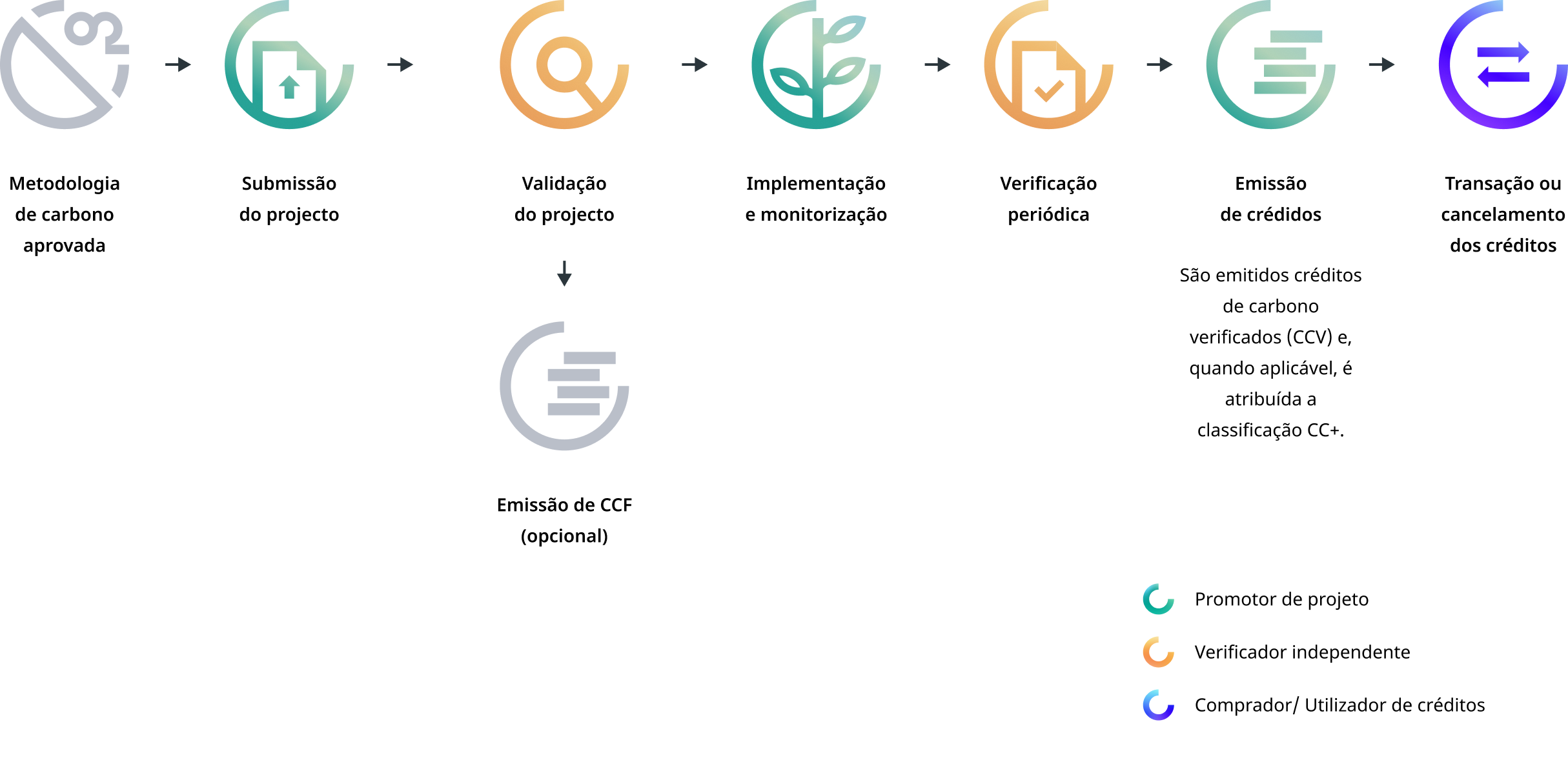

- Approved carbon methodology
- Project submission (Project developer)
- Project validation (Independent verifier)
- Issuance of CCF (optional)
- Implementation and monitoring (Project developer)
- Periodic verification (Independent verifier)
- Issuance of credits (Project developer): verified carbon credits (CCV) are issued and, where applicable, the CC+ classification is awarded.
- Transfer or cancellation of credits (Buyer/ User of credits)
For detailed and up-to-date information on the MVC – submitted projects, approved methodologies, the list of qualified verifiers, transparency data and frequently asked questions – or to submit a project, apply to become a verifier or express an interest in taking part, visit the official website of the Voluntary Carbon Market:
Stakeholders
The Voluntary Carbon Market (MVC) distinguishes between two types of stakeholders:
Market participants
- Project developers – public or private entities that develop and submit emission reduction or carbon sequestration projects;
- Independent verifiers – qualified and accredited entities responsible for validating and periodically verifying projects and, consequently, the carbon credits generated;
- Intermediaries and credit users – companies, public or private organisations and citizens that acquire credits to resell them, offset emissions or contribute voluntarily to climate action.
Competent authorities
- ApC – Agência para o Clima, I. P. – market supervisory authority, responsible for approving and revoking methodologies and imposing penalties on project developers in the event of non-compliance.
- ADENE – Portuguese Energy Agency – managing entity of the electronic platform for the registration and qualification of independent verifiers.
- Technical Monitoring Committee (CTA) – composed of representatives of public bodies (DGRM, ICNF, DGPM) and members of academia. It provides technical and scientific support, developing methodologies and issuing opinions on methodologies proposed by third parties, thereby contributing to the improvement of the market.
Key Concepts
What is a carbon methodology?
Carbon methodologies set out the rules and criteria that projects must meet in order to generate carbon credits under the Voluntary Carbon Market (MVC), including how to quantify, monitor and verify emission reductions or carbon sequestration.
For each project type, there must be a recognised and applicable methodology. Methodologies are assessed by the Technical Monitoring Committee and subject to public consultation before being approved by Agência para o Clima.
The list of approved methodologies is available, and kept up to date, in the Transparency tab of the MVC portal at: www.mvcarbono.pt
What is a carbon credit?
A carbon credit corresponds to one tonne of carbon dioxide equivalent (CO₂e) reduced or sequestered by a project. It may be traded or used to offset emissions or to contribute voluntarily to climate action.
In the MVC, carbon credits may take two different forms, depending on when they are generated:
- Future Carbon Credits (CCF) — issued before the emission reduction or carbon sequestration has actually taken place; they may help to finance projects in advance;
- Verified Carbon Credits (CCV) — issued after the emission reduction or carbon sequestration has been verified.
In carbon sequestration projects, carbon credits may also be classified as Carbon Credits + (CC+), a designation awarded to projects that, in addition to carbon sequestration, deliver significant benefits for biodiversity and natural capital.
European Framework — CRCF
Through Regulation (EU) 2024/3012, the European Union established the Union Certification Framework for Permanent Carbon Removals, Carbon Farming and Carbon Storage in Products (CRCF).
The CRCF is a voluntary certification framework, not a carbon market. Its aim is to establish common criteria and rules at European level for the robust and transparent certification of carbon removal activities and soil emission reduction activities.
The CRCF covers three main categories of activities:
- Permanent carbon removals, through solutions that remove carbon from the atmosphere or from biogenic sources and ensure its storage for several centuries;
- Carbon farming, including activities that promote the temporary sequestration of carbon in soils and biomass or reduce soil emissions;
- Carbon storage in products, through the incorporation of atmospheric or biogenic carbon into long-lasting products.
The CRCF and the Portuguese Voluntary Carbon Market are separate instruments, each with its own framework and rules. They can, however, be linked. Public or private certification schemes may apply to the European Commission for recognition under the CRCF, for one or more European certification methodologies, provided that they meet the requirements of the European framework.
The CRCF certification methodologies are being developed progressively by the European Commission. Methodologies have already been established for permanent carbon removal activities, in particular direct air capture with CO₂ storage (DACCS), capture of biogenic emissions with CO₂ storage (BioCCS) and carbon removal through biochar. The Commission has also adopted methodologies for carbon farming activities in agriculture and agroforestry systems on mineral soils, in the rewetting and restoration of peatlands and other organic soils, and in afforestation.
Agência para o Clima monitors the development and implementation of this European framework and represents Portugal in the European Commission’s Expert Group on Carbon Removals, which supports the development of the methodologies and other implementing rules of the CRCF.
For more information on the Carbon Removals and Carbon Farming Certification Framework (CRCF):